

What is an ELN? ELN stands for "Electronic Lab Notebook" which are software / digital alternatives...
Welcome back!
In our last article, we covered what an ELN actually is (to recap: it's a lot more than a digital notebook!). Now we’ll tackle the next big questions: who uses ELNs, what type of ELN is it, and why did they pick it?
Who uses ELNs?
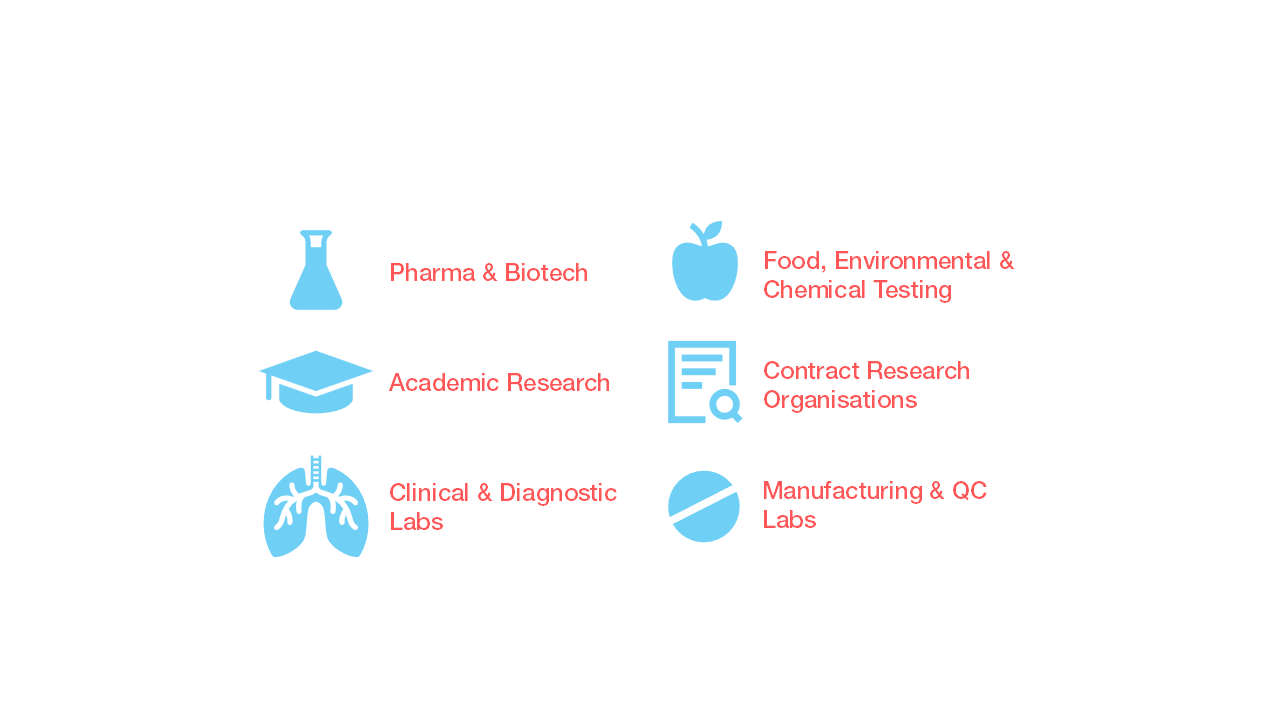
Well, if you don’t find “anyone with a lab” to be a satisfactory answer, ELNs are primarily used by engineers, technicians and scientists to document research, experiments, and procedures; but they’re used across a much wider range of industries and settings [1] like:
- Pharmaceutical & Biotech R&D
- Academic Research
- Research came a bit later (as mentioned in Part 1, the private sector was way ahead). Major universities have only recently started making use of ELNs [4], but word is spreading - in June 2024 the National Institutes of Health declared that the only approved form of lab notebook for its intramural researchers would be the ELN [5].
- Clinical & Diagnostic Labs
- There’s an eye on everything these labs do, so they need airtight audit trails and compliance with regulations like GxP and the FDA’s 21 CFR Part 11.
- Food, Environmental & Chemical Testing
- Think quality control, safety testing, and environmental monitoring. Structured data capture and traceability are critical for these industries.
- Contract Research Organisations (CROs)
- CROs collaborate across multiple clients and studies, so ELNs are essential for keeping data organised and compliant [6].
- Manufacturing & QC Labs
- ELNs support batch records, deviations, and process documentation [7], particularly in GMP (Good Manufacturing Practice) environments.
|
Did you know? 💡 More than half (57%) of companies surveyed by The Pistoia Alliance in 2021 said they use an ELN to enable better data management, inventory management, and scientist collaboration [8]. |
What types of ELN are there?
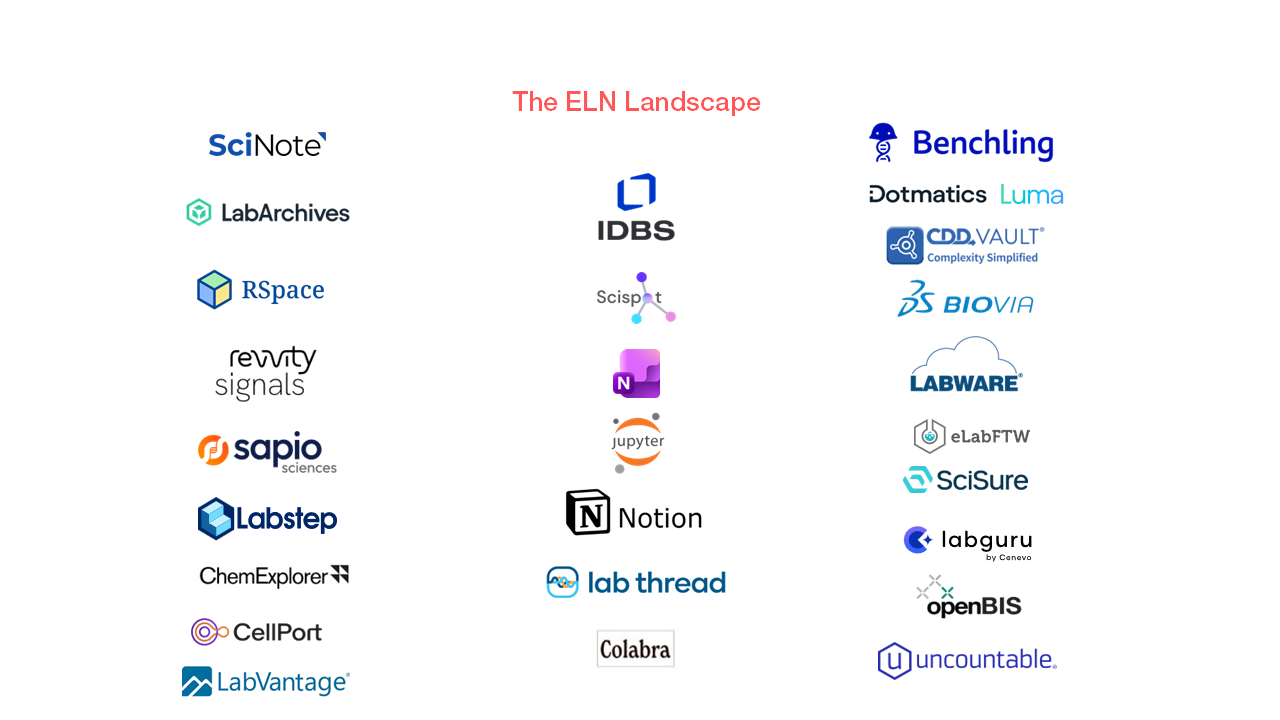
ELNs fall into a few categories and they don’t all do the same thing. Depending on your use case there could be one or multiple ELNs that you’ll find useful, and with a recent review listing 96 active ELN products (and 76 inactive ones!) [9], the market is crowded.
By Data
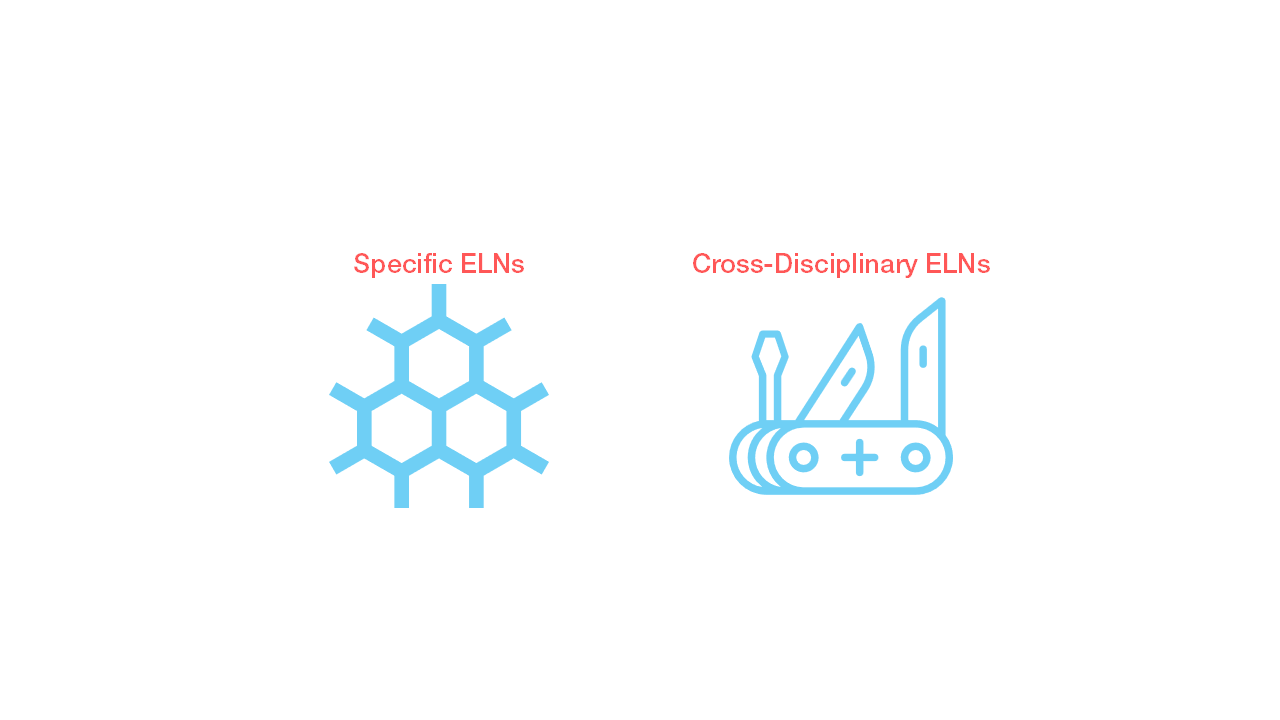
Specific ELNs
Built for one discipline / type of lab data. Examples would be chemistry-focused ELNs with molecule editors, or biology-focused platforms with sequence management.
Cross-Disciplinary (Generic) ELNs
Flexible, broad, and suitable for organisations with diverse lab data. The Swiss Army knives of the ELN world.
By Architecture
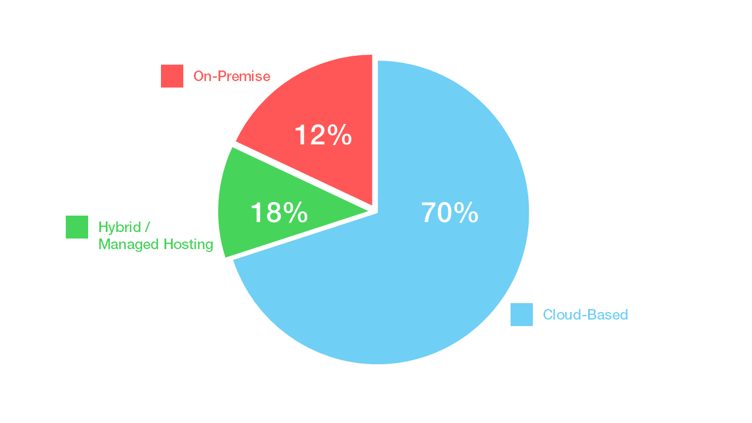
Cloud-Based (Software as a Service)
The dominant model, making up around 70% of the market [10]. Accessible from anywhere (if you have permission!), automatically updated, and typically lower upfront cost. Ideal for collaboration across sites and teams.
On-Premise
Installed on your own servers. Preferred by organisations with strict data sovereignty requirements or those in highly regulated environments who want full control.
Hybrid
The best of both worlds (or the worst, depending on who you ask). Some vendors offer flexible deployment options.
By Integration Scope
Standalone ELNs
Focused solely on the notebook function. Simple, clean, and does one thing well.
Integrated Lab Platforms
Combines ELN, LIMS, and SDMS functionality into a single environment. Efficient!
General-Purpose Tools Used as ELNs
Some labs use tools like OneNote, Notion, or even Jupyter notebooks as makeshift ELNs. They lack ELN-specific features like time-stamping and limited editing, but for smaller or less regulated labs they’re a decent starting point.
|
Did you know? 💡 Next-generation ELN platforms are embracing AI by integrating AI agents and LLM technology to automate experiment documentation, suggest protocols, and even assist with planning [11] [12]. The ELN of tomorrow might (fingers crossed) write half your notebook for you! |
So, why do they choose an ELN?
Because they need an ELN of course!
But really, the "why" varies dramatically depending on who you are. Across everything we’ve read so far, a few universal themes emerge that we explored in our first article:
-
Data Integrity
-
Everyone needs trusted and traceable records.
-
-
Searchability
-
Ever had to find that one singular file on your company SharePoint? Finding a result from 18 months ago shouldn't require manually sifting through months of data.
-
-
Collaboration
-
Science is a team sport, and ELNs make it easier to share, review, and build on each other's work.
-
-
Futureproofing
-
Organisations are thinking about AI-ready data foundations that will shape the next generation of R&D [13].
-
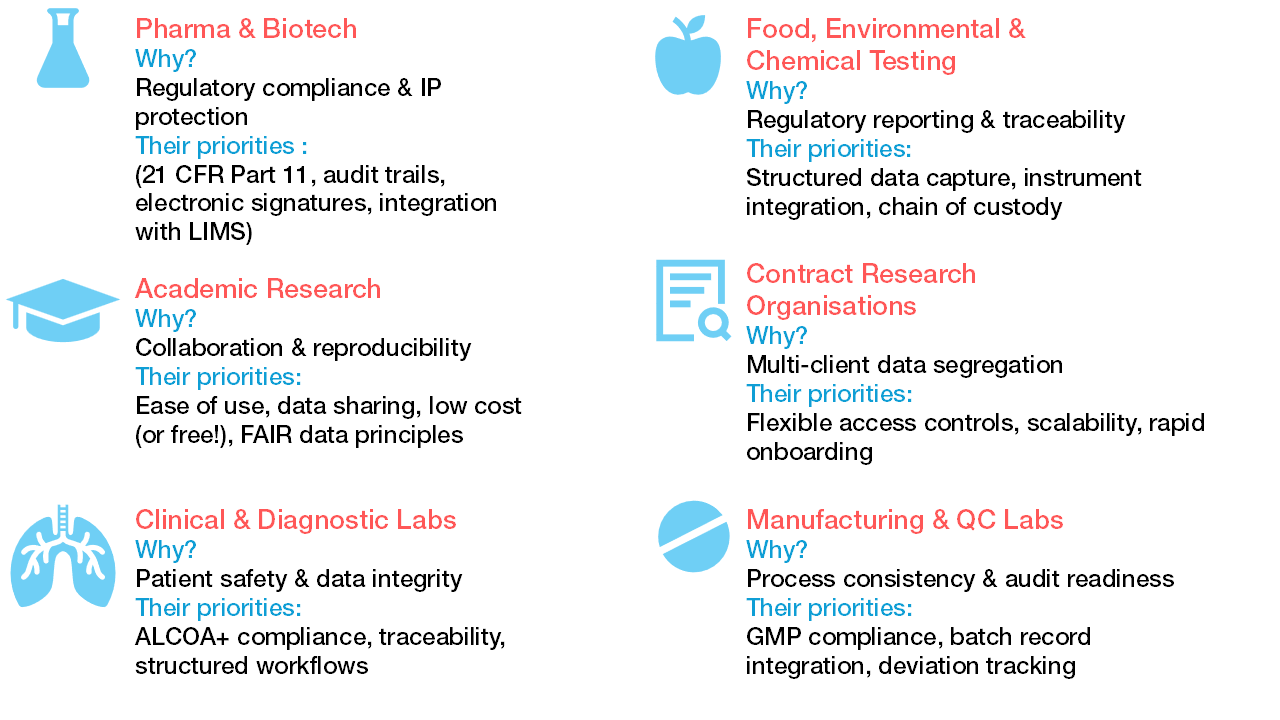
As shown in the image above, pharma R&D would value broad compliance and integration [2] [7], academics would value ease of use and cost [5], CROs would value onboarding and scalability [6], and manufacturing would value GMP compliance and deviation tracking [7]. While they all might need an ELN, their different uses complicate selection quite a bit.
Which one should you pick?

Unfortunately, there’s no easy answer here – the best I can say is it depends. It depends on your discipline, your regulatory environment, your existing systems, your team size, your budget, and most importantly – your willingness to change.
An ELN that works for a 500-person pharma R&D site might be completely wrong for a 10-person academic lab, and vice versa. The key is understanding your own needs first, then finding the ELN that fits.
If you happen to need a hand exploring an ELN solution for yourself, or have any other questions about improving your lab experience please click here to book a meeting with us to discuss!
Until next time!
- Nathan and the ADIGILEAP team.
[1] https://genemod.net/eln-software
[2] https://intuitionlabs.ai/articles/eln-vs-lims-vs-sdms-pharma-informatics
[4] https://eln.wisc.edu/about/about-electronic-lab-notebooks/
[5] https://oir.nih.gov/system/files/media/file/2024-07/best_practices-keeping_eln-trainee_0.pdf
[6] https://www.csolsinc.com/resources/benefits-of-an-eln-in-biopharma
[7] https://www.sapiosciences.com/blog/best-elns-for-gmp-and-pharmaceutical-manufacturing/
[8] https://www.labmanager.com/how-elns-can-help-to-drive-innovation-in-life-sciences-26660
[9] https://www.nature.com/articles/s41596-021-00645-8
[10] https://www.idbs.com/what-is-an-eln/
[12] https://www.benchling.com/blog/ai-tools-for-the-modern-lab